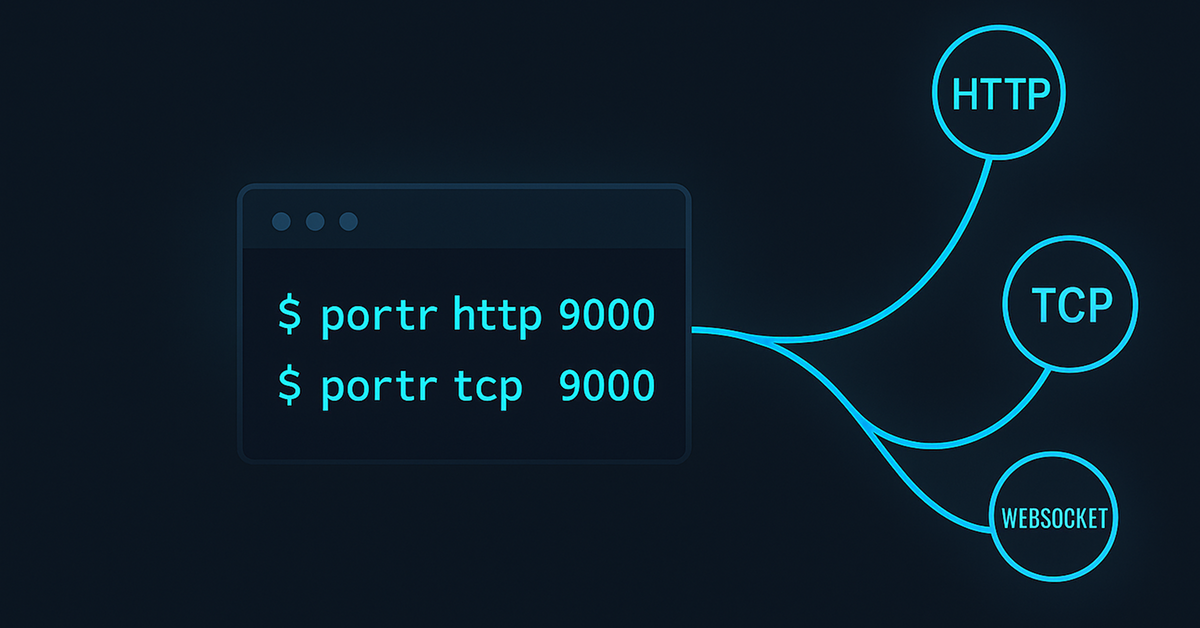
Details about Portr
Fully self-hosted tunneling tool that exposes local services securely to the internet without relying on third-party clouds
Built for development teams needing collaborative previews, webhook testing, and remote access to localhost environments
Open-source under Apache 2.0 license, with active GitHub repo (stars not specified, but community-focused for contributions)
Lightweight and performant, using modern Rust for the core engine to handle high concurrency with minimal overhead
Supports multiple protocols (HTTP, TCP, WebSockets) for versatile use in web, API, and real-time app development
Easy Docker deployment for quick setup in any CI/CD pipeline or local machine
#What is Portr?
Portr is a developer-centric, self-hosted alternative to tools like ngrok, designed for engineering teams and indie devs who prioritize privacy, control, and cost-efficiency when exposing local development servers to external collaborators or services. Its core value is providing a secure, zero-trust tunnel that keeps your infrastructure in-house, eliminating data leakage risks and vendor lock-in while enabling seamless sharing for testing and debugging. Built primarily in Rust for the tunneling core, with a web-based dashboard in React and Node.js for management, it's ideal for use-cases like previewing frontend builds in team reviews, ingesting webhooks for Stripe or GitHub integrations during dev, or remotely accessing database UIs without VPN hassles—perfect for remote-first workflows in SaaS startups or open-source projects.
#Features ⚡
Secure Tunneling: Establish encrypted tunnels from localhost to a public URL via your self-hosted server, supporting HTTPS with auto-generated certs for production-like security.
Team Dashboard: Intuitive React-based UI for creating, managing, and monitoring tunnels, with role-based access for collaborators to view or inspect traffic without full control.
Multi-Protocol Support: Handle HTTP/HTTPS for web apps, TCP for custom ports, and WebSockets for real-time features like Socket.io testing—all in one unified setup.
Traffic Inspection: Built-in request/response logging and replay tools to debug issues, inspect headers/payloads, and simulate edge cases during development.
Webhook Endpoints: Dedicated mode for receiving and forwarding webhooks to local services, with signature verification to ensure authenticity from providers like Twilio or AWS.
CLI Integration: Command-line tools for quick tunnel spins from terminals, integrated with scripts for automated testing in GitHub Actions or Jenkins pipelines.
Scalable Architecture: Docker Compose setup for easy scaling across multiple instances, with Prometheus metrics export for monitoring tunnel health and usage.
#Pros ✅
Total privacy control by keeping tunnels on your infrastructure, avoiding third-party data exposure
Cost-effective long-term—no per-minute fees like cloud tunnels, ideal for high-volume team use
High performance from Rust core handles thousands of concurrent connections without lag
Open-source flexibility allows custom extensions for unique workflows or security policies
Simple onboarding with Docker means devs can spin it up in minutes, no steep learning curve
#Cons ⚠️
Requires self-management of the host server, adding ops overhead compared to fully managed services
Lacks out-of-box mobile app support for on-the-go access, focusing more on desktop/CLI use
Community still emerging, so fewer pre-built plugins than mature alternatives like ngrok
#Included Components - Templates
Core Tunneling Server: Rust-based binary for the tunnel engine, handling ingress/egress with encryption.
Web Dashboard: React app for tunnel management, with templates for user auth and access controls.
CLI Tool: Node.js-wrapped binary for command-line tunnel creation and inspection.
Docker Compose Stack: Pre-configured YAML for deploying server, dashboard, and database (SQLite/PostgreSQL).
Traffic Logger: Middleware component for capturing and exporting request data to files or ELK stack.
Webhook Handler: Dedicated endpoint templates for common providers, with validation scripts.
Metrics Exporter: Prometheus-ready templates for monitoring dashboard integrations.
Example Configs: YAML/JSON templates for multi-tunnel setups, auth providers, and CI scripts.
#Pricing 💸
Completely free and open-source under Apache 2.0 license—no tiers, subscriptions, or hidden costs for core functionality.
Self-hosting requires only your server resources (e.g., VPS at $5/month), with no licensing fees for commercial or team use.
Community support via GitHub issues; optional paid consulting for custom setups available through contributors.
#Integrations 🧰
Deployment: Docker, Docker Compose, Kubernetes for containerized hosting.
Monitoring: Prometheus and Grafana for metrics and alerts.
CI/CD: GitHub Actions, Jenkins, GitLab CI for automated tunnel spins in pipelines.
Auth: OAuth providers like GitHub, Google via dashboard integration.
Logging: ELK Stack (Elasticsearch, Logstash, Kibana) for advanced traffic analysis.
Databases: SQLite for lightweight, PostgreSQL for scaled setups.
Protocols: HTTP/HTTPS, TCP, WebSockets natively; extendable to SSH via plugins.
Frequently Asked Questions
Is Portr completely free?
Yes—open-source with no costs beyond your hosting; unlimited use for any scale.
How does it compare to ngrok?
Portr is self-hosted for privacy, while ngrok is cloud-managed; choose Portr for control.
Can I use it for production?
It's dev-focused but secure enough for staging; not recommended for live traffic.
Portr
Expose local HTTP, TCP & WebSocket with a secure self-hosted tunnel.
Resource Types:
UI Kits :
Shadcn UITechnology Stack :

Have a product?
Submit your Shadcn product to AllShadcn, get featured, and drive genuine traffic while showcasing your work to the world. Turn your creativity into revenue and begin selling today! 🚀